HOLT, Fla., June 8, 2023—Controlled burns in the panhandle routinely turn the skies grey.
Occasionally, brush fires occur and sometimes get out of control, filling the air with smoke, as the Five Mile Swamp fire did in Santa Rosa County in 2020.
Related: “Holt Fire lends hand to Santa Rosa brush fire”
The fire there caused Interstate 10 to shut down due to low visibility from the smoke.
However, that’s nothing compared to what’s happening on the east coast of the United States as Canadian wildfires rage out of control.
As of Tuesday, there were more than 435 active fires throughout Canada with more than half listed as being out of control.
In New York Tuesday, air quality was worse than Delhi, India, where air quality is so bad, average citizens are losing almost nine years off their life spans, according to an annual air quality life index there.
Today’s forecast for New York City is better; however, Philadelphia and the Washington, D.C., area are expected to be hazardous, according to the Environmental Protection Agency’s Air Quality Index at AirNow.gov.
According to a tweet by the Washington Weather Gang, the forecast team at the Washington Post, “The air is compromised from Minneapolis to DC to Boston, and the worst from western NY to around Ottawa.”
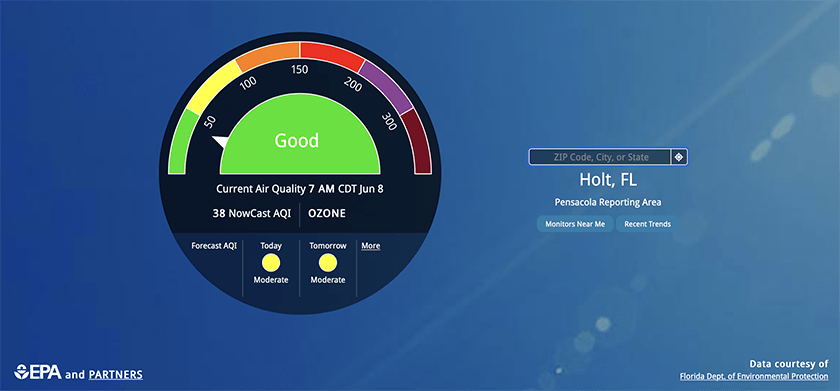
Portions of the panhandle may experience some moderate ozone today and tomorrow from the Canadian wildfires, according to AirNow.gov.
People sensitive to ozone, the primary air pollutant, should consider reducing outdoor activity, according to the EPA.
It’s important to note that the forecast is based on which way the wind blows, literally.
Air Quality Index
The EPA is responsible for protecting human health and the environment and monitors the air quality throughout the United States.
Every day, the Air Quality Index, or AQI, indicates how clean or polluted the outdoor air is and the associated health effects.

Ground-level ozone and airborne particles are two pollutants that pose the greatest threat to human health, according to the EPA. The Canadian wildfires fall into those categories as the smoke spreads across portions of the United States.
The AQI is like a yardstick that runs from 0 to 500. The higher the value, the greater the level of pollution and greater the health concern.
By tomorrow, the worst of the pollution from the Canadian wildfires is expected to move west, away from the east coast.
 Holt Enterprise News