HOLT, Fla., Dec. 2, 2023—Another hurricane season is in the books after the fourth most active one in history.
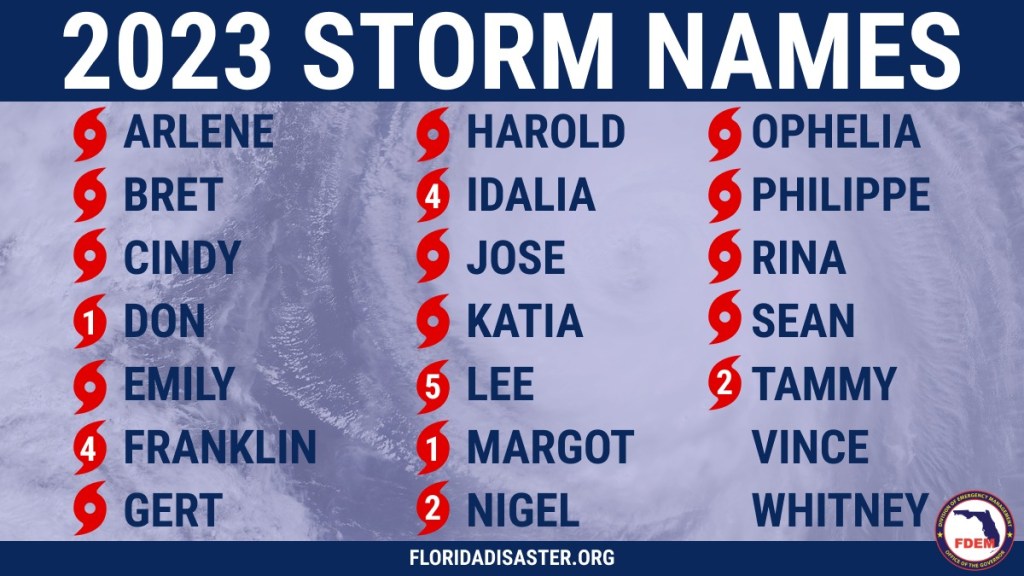
While it may have seemed uneventful for northwest Florida, there were 20 storms that used up all but two names on the lists. Of the 20, seven storms became hurricanes with three reaching major hurricane strength.
An average hurricane season has 14 named storms with seven becoming hurricanes and four of them becoming major storms (category 3, 4 or 5).
The first storm of 2023, which developed in the northwest Atlantic in January as a low pressure area, became a subtropical storm Jan. 16 and was recognized as such by the National Hurricane Center in May.
By the time the official start of the season rolled around June 1, tropical storms Arlene, Bret and Cindy had developed. The first hurricane to form was Don on July 22, which remained a category 1 storm.
The months of August through October are considered the peak of the hurricane season, and true to form, 17 systems formed during this timeframe.
By mid-August, there had been four named storms in less than 48 hours: Emily, Franklin, Gert and Harold. By the end of the month, the season total was up to 11 storms. Eight previous seasons matched this formation pace: 2005 (year of Katrina), 2020 with 30 named storms and 2021 (year of Hurricane Ida).
Tropical Storm Harold formed in the Gulf of Mexico Aug. 22. It was the fourth-named storm to form within 39 hours making this season the fastest for four storms to form and breaking a 1893 record.
Hurricanes Franklin, Idalia and Lee strengthened into major storms with Franklin and Idalia reaching category 4 strength and Lee being the only category 5 storm of the season.
Storms that reached the United States included Tropical Storm Harold that made landfall in Texas, Hurricane Idalia that stormed across south and central Florida as a high-end category 3 system and Tropical Storm Ophelia that made landfall in North Carolina.
El Niño effect
This hurricane season was marked by the presence of El Niño. Normally during an El Niño period, hurricane activity is lessened due to cooler waters and wind shear.
However, this year’s El Niño was competing with record hot ocean and Gulf waters resulting in the most storms for an El Niño year on record.

Hurricane Idalia
By far the most damaging storm was category 4 Hurricane Idalia. Forty-six counties in Florida were placed under a state of emergency in the days before the storm arrived.
Idalia approached the Big Bend region as a category 4, but weakened to a high-end category 3 just before landfall, making it the most powerful hurricane to hit the area since 1896. The hurricane brought record-breaking storm surge from the Big Bend region to Tampa Bay. Cedar Key reported water levels at a record 6.8 feet due to storm surge.
Idalia caused significant damage across the Big Bend region and into southeastern Georgia. Four people died in storm-related incidents in both states. Early estimates of damage costs is around $2.2 to $5 billion.
The World Meteorological Organization retired two names from the Atlantic hurricane list after the 2022 season: Fiona and Ian. To date four I-named storms have been retired, more than any other letter of the alphabet: Ian (2022, Cat 4), Ida (2021, Cat 4), Irma (2017, Cat 5) and Igor (2010, Cat 4).
It is likely Idalia will become the fifth I-named storm to be retired once final assessments are completed.
 Holt Enterprise News