
SHALIMAR, Fla., Oct. 16, 2024—County commissioners declined to accept the final report of the nine-month study on north Okaloosa growth during yesterday’s board meeting in Shalimar.
After about an hour-and-a-half presentation and discussion, the Okaloosa County Board of County Commissioners instead approved to “acknowledge” the work of Inspire Placemaking Collective Inc. rather than accept the final report as outlined in the nearly $1 million contract signed in February.
According to their comments following the presentation by Inspire, some of the commissioners seemed taken aback by the information presented and appeared to be unfamiliar with the details in the report.
District 3 Commissioner Nathan Boyles, who attended almost all nine public town halls, including the final meeting Monday in Crestview, stated up front that he would be voting “yes” to accept the final report.

During Monday’s public presentation, when the recommendations to revert north county agriculture areas to the original base density of one dwelling unit per 10 acres and to prohibit further increase in density and commercial intensity were announced, applause broke out in the audience.
There was no applause at the recommendations during the final report presentation at Tuesday’s commissioners meeting.
Instead, questions were raised about the recommended changes to the current comprehensive plan and land use codes and how quickly the timeline of the study was progressing.
“The timeline is too fast for me,” said District 4 Commissioner Trey Goodwin. “It’s about making major changes—240,000-something acres of land in Okaloosa County and that’s a big deal to bite off.”
District 2 Commissioner Carolyn Ketchel agreed with Goodwin.
“I don’t want to be rushed,” she said. “There’s a lot of people involved in this—a lot—and I want to make sure we do it correctly. I am not going to rush this process. I’m not going to do it.”
Goodwin’s motion to acknowledge rather than accept the report was approved by the commission.
The compressed timeline was stipulated in the contract signed between Okaloosa County and Inspire.
The decision not to accept the final report came as a disappointment to county residents attending the meeting who supported the findings after months of participation in the study.
“Their [Inspire’s] report’s been out since the 27th of September,” said Kathleen Moneypenny of Laurel Hill following the board’s decision. “That’s 19 days. You each could have read it online. We’ve all have.”
Public comments prior to Inspire’s presentation to the board were mostly favorable to the findings of the report.
Two businessmen cautioned the board about the findings, however. Felix Beukenkamp, representing the Building Association Industry of Okaloosa-Walton County, requested more time to study the report.
“We need a little more time—lot of information in there, some good, some we’re concerned about,” he said.
Former resident Kermit George, an engineer with Deep South Engineering Services, also cautioned the board about the findings, stating that it will affect affordable housing.
“I think it will make un-affordable housing,” he said, adding that less available land for development will drive up development costs and decrease property values in agriculture and rural residential identified areas.

Study findings
Formal study of north Okaloosa County growth began in March and culminated with a ninth and final town hall in the Crestview Community Center Monday.
The study covered 245,000 non-incorporated acres with 40,764 residents of north Okaloosa. The incorporated cities of Crestview and Laurel Hill were not included in the study.

The first document required in the contract consisted of a public priorities report which identified three major areas of concern by north county residents: preserving the rural and agriculture character, concern with inadequate infrastructure and existing development, and alarm regarding a lack of transparency and coordination in managing growth.
“The contract specifically stated that this final report needed to reflect the public priorities report,” said Inspire president George Kramer. “It was overwhelmingly unanimous to protect the rural character of Okaloosa.”
Based on current growth projections, the north area is expected to grow by 7,893 people by the year 2050.
However, allowable growth of north Okaloosa under the current comprehensive plan and land use codes supports a population of 351,039, a 718 percent increase.
“That figure far exceeds most cities in the state, all but about three,” said Kramer. “It’s more than the projected growth for the entire county. The county allows far more growth in north Okaloosa than is anticipated.”
And while the current comprehensive plan identifies an urban development boundary, there is development going on outside that designated area.
“There are development patterns inside and outside the current urban area development boundary blurring the boundary lines between urban and rural,” said Kramer. “We’re not suggesting that 351,000 people are going to move to north Okaloosa, but we know the current allowable densities will support that population.”
Recommendations
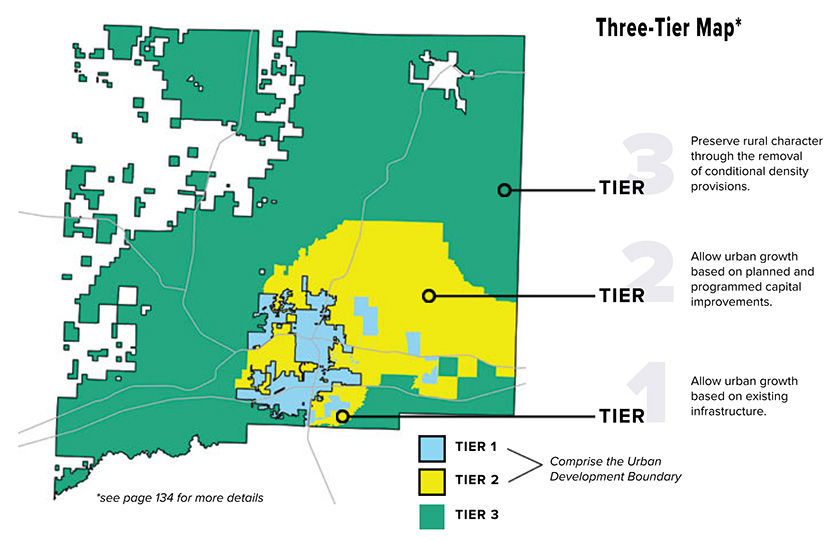
In addition to reverting north county agriculture densities to its original baseline, the final report recommends the comprehensive plan be amended to identify a three-tier system. Tier 1 would identify where current central water and sewer exist. Tier 2 areas would include areas planned to be served by public water and sewer. And Tier 3 would be where there are no plans for public water and sewer, which would be areas primarily west of the Yellow River and locations north of Crestview.
“Tiers 1 and 2 will provide the basis of a new urban development boundary. Growth should be directed toward existing and planned infrastructure,” said Kramer. “There are no plans for public water and sewer in the areas we’ve designated as Tier 3. That’s where we want to protect rural character.”
Holt and Baker were designated as rural communities in the report, but the study recognized there are other lands that are not agriculture or rural residential, such as mixed use and industrial.
“Both of those have some urban land uses that are proposed to be changed through this report, but there probably needs to be additional plans looked at on how to protect rural character in those areas,” said Kramer.
For now, no further motions were approved by the board of commissioners although Boyles recommended a motion to provide feedback to Inspire and some level of direction, to direct county staff to work with the consultants to establish a Tier 1 and 2 alternative boundaries map.
“This process was a worthwhile process,” said Boyles. “I think it will ultimately make this county better.”
 Holt Enterprise News